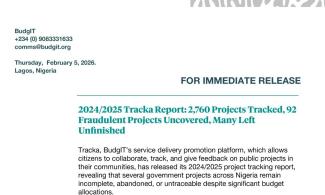
Civil society organisation BudgIT, through its citizen-led project tracking platform Tracka, revealed this in a newly released 2024/2025 Project Tracking Report, which assessed the status of 2,760 projects across 28 states, exposing what the organisation described as “systemic gaps between public spending and tangible development outcomes.”
At least 92 government-funded projects across Nigeria were fraudulently delivered during the 2024/2025 budget cycle, while hundreds of others were abandoned, uncompleted, or not executed despite budgetary allocations.
Civil society organisation BudgIT, through its citizen-led project tracking platform Tracka, revealed this in a newly released 2024/2025 Project Tracking Report, which assessed the status of 2,760 projects across 28 states, exposing what the organisation described as “systemic gaps between public spending and tangible development outcomes.”
According to the report published on its official X (former Twitter) handle, out of the 2,760 projects monitored, 1,438 were completed, 660 were ongoing, 99 were abandoned, 471 were not done at all, while 92 projects were classified as fraudulently delivered.
https://x.com/i/status/
“Fraudulently delivered projects were characterised by the diversion of project funds and projects to other locations, disbursement of funds for projects completed in previous budget cycles without new implementation, projects partially completed, and poorly executed projects,” Tracka stated.
The report further disclosed that Imo State recorded the highest incidence of fraudulent projects at 17.43 per cent, followed by Lagos (12.73 per cent), Kwara (11.76 per cent), Abia (10.67 per cent), and Ogun (8.33 per cent).
“These five states account for 57.1 per cent of all fraudulently delivered projects, representing ₦8.61 billion of the total ₦15.07 billion disbursed for projects in this category,” the report noted.
Tracka explained that the 2024/2025 tracking exercise included targeted monitoring of strategic infrastructure, such as dam projects, revitalised primary healthcare centres, and federally funded projects in the Niger Delta.
On dam-related projects, the report said Tracka tracked 16 projects across 13 states with a combined value of ₦432 million.
“Of the 16 projects tracked, none were completed at the time of assessment. Four were abandoned, six were progressing slowly, and six had yet to commence despite prior funding,” the report said.
Tracka warned that weak oversight in the dam sector could have severe consequences.
“Dams are critical for water management, irrigation, and power generation, and weak oversight in this sector can have ripple effects on national energy supply, food production, and economic stability,” it added.
On healthcare, the organisation tracked 47 revitalised primary healthcare centres across 25 states.
Of these, 26 facilities showed visible improvements in infrastructure or equipment, 12 were under renovation, eight had no intervention despite being listed as revitalised, while one facility was completely abandoned.
“In many neglected facilities, residents continue to face long travel distances and substandard care due to inadequate staffing, poor equipment, and weak sanitation,” the report said.
It added that limited public disclosure of disbursement data made it difficult to determine whether delays were caused by funding gaps, contractor inefficiency, or weak supervision.
In the Niger Delta, Tracka monitored 48 federally funded projects across Akwa Ibom, Cross River, Delta, and Rivers states.
“While 29 projects were completed and produced measurable community benefits, 13 had not commenced, four were ongoing, and two were untraceable despite confirmed funding,” the report stated.
Despite the grim findings, Tracka highlighted 15 success stories driven by citizen engagement, including the revitalisation of Kaida Sabo Primary Healthcare Centre, renovation of Nawaerudeen Primary School in Plateau State, completion of a stalled healthcare centre in Ikirun, empowerment programmes for persons with disabilities in Katsina State, erosion control projects in Rivers State, and borehole water projects in Akwa Ibom State.
Commenting on the findings, Head of Tracka, Joshua Osiyemi, said the report confirms longstanding concerns about Nigeria’s public finance system.
“The 2024/2025 Tracka report confirms what we have long known. Allocation of funds does not guarantee project delivery. Citizen oversight is not optional; it is essential,” Osiyemi said.
He revealed that Tracka monitored 11.2 per cent of budgeted federal projects.
“Tracka monitored 11.2 per cent of the budgeted projects — 2,760 out of 24,553 (ERGP + ZIP) — demonstrating what is possible. If just five per cent of Nigerians engage in oversight, monitoring could reach 50 per cent, significantly reducing opportunities for corruption and greatly improving service delivery and quality of life across communities,” he said.
Tracka called on the Federal Government to publish detailed project information, release timely disbursement data, strengthen supervision, and prioritise socially impactful projects.
“State governments must treat federal allocations to them as strategic development tools, not discretionary or patronage funds,” the organisation said.
It also urged anti-corruption agencies to “act preventively, close systemic loopholes, and ensure investigations yield tangible results.”
Citizens were encouraged to visit project sites, document progress, and use civic platforms such as Tracka to reinforce accountability at the grassroots level.
“The 2024/2025 report serves both as a warning and an invitation: without accountability, public resources will continue to be wasted; but with citizen engagement, institutions and communities can ensure that public spending delivers real, measurable impact,” the statement concluded.