Umeh, however, insisted that the Senate must not make laws that are self-serving, stressing that the core responsibility of lawmakers is to enact legislation that corrects problems in Nigeria and strengthens the credibility of the country’s democratic process.
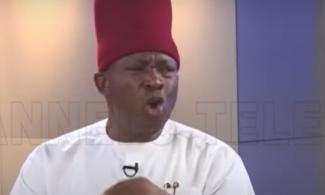
Senator representing Anambra Central, Victor Umeh, has said Nigerians are right to be angry with the Senate over reports surrounding the consideration of the Electoral Act Amendment Bill, admitting that lawmakers have been subjected to insults and public outrage because Nigerians feel disappointed and betrayed.
Umeh, however, insisted that the Senate must not make laws that are self-serving, stressing that the core responsibility of lawmakers is to enact legislation that corrects problems in Nigeria and strengthens the credibility of the country’s democratic process.
Speaking on Channels Television on Thursday amid growing controversy over the Senate’s handling of the Electoral Act Amendment Bill 2026, Umeh said the issue of elections is extremely sensitive and must not be treated with levity or political gamesmanship.
“The issue of elections is a very sensitive one. Very, very sensitive. It’s not something anybody can do playing hide and seek. We must agree to it,” Umeh said.
According to him, Nigerians have reacted angrily to reports from the Senate because the outcome made public did not reflect what was agreed upon during internal deliberations.
“Nigerians have called us all manners of names. Well, we have to take the insult because we have disappointed them from the news they got,” he said.
Umeh maintained that no senator should participate in making laws that serve personal or partisan interests, warning that such actions would further erode public trust in democratic institutions.
“We are for the Nigerian people. Nobody should make a law that will be self-serving. We should be making laws that will correct problems in Nigeria and put this country on a very strong standing so that we can have a credible system,” he said.
The senator explained that the process leading to the amendment of the Electoral Act was thorough and deliberate, involving first and second readings, zonal public hearings across the country, extensive consultations with stakeholders, and reports from a joint committee of the National Assembly.
“It takes a process to make a law. A bill must go through readings, public hearings and consultations before debate and passage. Laws are not made for the sake of it; they are made to solve problems,” Umeh stated.
He said the amendment to Section 60 of the Electoral Act 2022, which deals with the transmission of election results, emerged as one of the strongest demands from Nigerians during public hearings nationwide.
According to Umeh, the controversy around result transmission became unavoidable after the 2023 general elections, which were widely disputed and eventually challenged up to the Supreme Court.
“During the presidential election cases, arguments were taken on whether results uploaded to the IReV portal had legal backing. The Supreme Court held that electronic transmission was not expressly provided for in the law and discountenanced such evidence,” he said.
Umeh noted that the Supreme Court’s position exposed a major gap in the law, which stakeholders agreed must be urgently addressed to avoid a repeat of the 2023 experience.
“Stakeholders agreed the law must be amended to provide for electronic transmission, so courts would not again dismiss electronically transmitted results as ‘unknown to law’,” he said.
He explained that both chambers of the National Assembly worked independently on the amendment, adding that the House of Representatives had already passed its own version of the bill with clear and unambiguous provisions mandating electronic transmission of results.
According to Umeh, when the Senate considered the bill in a closed executive session, there was overwhelming agreement in favour of electronic transmission.
“Over 85 per cent of senators agreed to electronic transmission. It was common ground. Even the ad hoc committee of the Senate agreed to it,” he said.
He further clarified that the only modification agreed upon during the closed session was the removal of the phrase “in real time,” due to concerns about possible network challenges in remote areas of the country.
“It was only ‘real time’ that was expunged because of network issues. Transmission itself was never in dispute,” Umeh explained.
He said confusion arose during plenary when a motion was reportedly moved to replace the word “transmission” with “transfer” without any debate.
“There was no debate on it. If debate had been allowed, it would have taken us back to the executive session where the issue had already been exhaustively discussed and resolved,” he said.
Umeh argued that replacing “transmission” with “transfer” would effectively render the provision meaningless.
“You cannot talk about transfer to the IReV portal without electronic transmission. How do you transfer to a portal if it is not done electronically?” he asked.
He insisted that the Senate never agreed to revert to the wording of the 2022 Electoral Act, which merely allowed INEC to “transfer” results as it deemed fit.
Reacting to the public backlash, Umeh said Nigerians’ outrage clearly showed that the outcome announced from plenary did not reflect the consensus reached by lawmakers behind closed doors.
He said Nigerians expect a more credible, transparent, and trustworthy electoral process, especially after the controversies of the 2023 elections.
However, Umeh stressed that the legislative process on the bill was not yet complete, noting that the Senate had not adopted its Votes and Proceedings from the sitting in question.
“We have not finished. The Votes and Proceedings of yesterday have not been approved. It is only approved proceedings that go to the conference committee for harmonisation,” he said.
He expressed confidence that the issue would be corrected during the harmonisation process between the Senate and the House of Representatives.
“When we return to approve the Votes and Proceedings, the question will be asked whether it truly reflects what we did. I believe the agreed position on electronic transmission will be restored,” Umeh said.
The Senate on Tuesday passed the Electoral Act Amendment Bill 2026, retaining the existing provision that allows the Independent National Electoral Commission (INEC) to transfer election results as it deems fit, rather than making electronic transmission mandatory.
The bill also shortened election timelines, adopted the Bimodal Voter Accreditation System (BVAS) while retaining the Permanent Voter Card (PVC) as the only recognised voter identification, reduced penalties for PVC trading to two years’ imprisonment with a ₦5 million fine, and established a conference committee to harmonise the bill with the version passed by the House of Representatives.