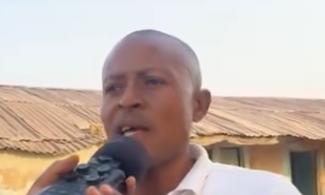
According to him, his dismissal followed a devastating Boko Haram attack in Baga, Borno State, where he said at least 117 of his colleagues were killed.
A former Nigerian soldier has recounted a harrowing account of how he was allegedly dismissed from the Nigerian Army after nearly two decades of service.
He said the decision stemmed from nothing more than raising his hand to ask a question during a briefing by a senior commander following a deadly Boko Haram attack.
Speaking on a podcast hosted by Lucky Udu, the dismissed soldier said his life has been in ruins since December 2015, when he was thrown out of the Army in the aftermath of fierce counter-insurgency operations in the North-East, plunging him and his family into poverty, shame and deep psychological trauma.
“I am not a wounded soldier. I am a dismissed soldier.”
According to him, his dismissal followed a devastating Boko Haram attack in Baga, Borno State, where he said at least 117 of his colleagues were killed.
He explained that he was serving with the 118 Task Force Battalion, which was deployed to frontline locations in Maiduguri and Baga, areas that witnessed repeated and deadly encounters with insurgents.
Recounting the incident that allegedly sealed his fate, the former soldier said that after the attack, surviving troops were regrouped at their concentration area in Gubio, where their brigade commander came to address them.
WATCH: Nigerian Ex-Soldier Reveals How Army General Jamilu Sarham Unjustly Dismissed Him For Questioning How Boko Haram Killed 117 Personnel pic.twitter.com/EeQMLuqncK
— Sahara Reporters (@SaharaReporters) February 7, 2026
“After his address, he asked us if there was any question,” the ex-soldier recalled. “I raised my hand. Some other soldiers also raised their hands.”
What he thought would be a normal opportunity to speak, he said, suddenly turned into a nightmare.
“He asked me to come out. As I was coming out, expecting to ask my question, I was disarmed immediately and taken to Maimalari Cantonment,” he said. “There, I was chained and handcuffed.”
He said he spent 10 days in detention before his commanding officer visited him and informed him that he had been charged with disobedience to an order.
“I asked her, ‘You were there when the commander asked if there was any question, and I raised my hand. Not only me,’” he said. “But I was singled out. he told me his hands were tied and that there was nothing he could do.”
The former soldier alleged that the mass dismissal of troops involved in the operation was approved by a senior officer, whom he identified as General Jamilu Sarham.
“At that operation, that general that dismissed us, his name is General Jamilu Sarham,” he said. “He dismissed about 300 and something soldiers. From 118 and 157 Task Force Battalion in Maiduguri and Baga. If you need the names, I can bring out their names.”
He said he joined the Nigerian Army at the age of 18, devoting his entire youth and adult life to military service, only to be sent away without benefits or support.
“I am ashamed even to go down to my hometown,” he said. “Because knowing that I dedicated myself right from youth, out of 18 years. I joined the Army at the age of 18.”
According to him, he enlisted in 2003 and took part in numerous military operations within and outside Nigeria.
“Since 2003, I fought,” he said. “I have participated in different operations. I participated in hybrid operations in the Darfur region. I participated in Operation Pulo Shield. I participated in different internal operations, especially in Maiduguri.”
He described in grim terms the scale of casualties suffered by his battalion during counter-insurgency missions against Boko Haram.
“Our battalion, 118 Task Force Battalion, we spent just two days, and on the third day in Maimalari, at Tere Tere, we encountered Boko Haram,” he said. “We lost about 115 soldiers.”
According to him, the bloodshed continued across several locations in the North-East.
“They took us to Gajibo. 118 Task Force Battalion and 119, we lost 75 soldiers. At Tunkushe, we lost 300 and something soldiers,” he said.
The ex-soldier revealed that there was a glimmer of hope when the late Chief of Army Staff, Lieutenant General Ibrahim Attahiru, reportedly showed interest in addressing their situation.
“If not for the late Attahiru, may he rest in peace, the then Chief of Army Staff,” he said. “When he came in, he compiled all our names. He asked us to report at Jaji by Monday.”
That hope, however, was short-lived.
“Unfortunately, he died on Friday, on his way to the Nigerian Army Depot for a parade,” the ex-soldier said. “Since then, nobody has been answering us.”
He said he and other dismissed soldiers wrote several petitions and appeals to the Appropriate Superior Authority (ASA), but all efforts yielded nothing.
“There are places you go to appeal,” he said. “We appealed, but nobody answered. There has never been any response.”
Nearly a decade after his dismissal, he said his life remains marked by instability, humiliation and hardship.
“My case has been for 10 years now,” he said. “Since December 2015. I have been writing with no rest.”
He said he no longer receives any salary or benefits and now survives on handouts.
“They don’t pay me anymore. I’m not collecting salary. I’m just surviving,” he said. “Sometimes friends will call me and dash me ₦5000. That’s it.”
According to him, his family has suffered deeply as a result of his ordeal. His three children are no longer in school, while his wife struggles daily to keep the family afloat.
“It has not been easy,” he said. “Sometimes through the help of my friends or siblings, they send ₦10,000. I will give her small money to buy things like tomatoes and beverages so she can go and sell. My wife is hawking.”
He added that he no longer has a permanent place to live.
“As I am now, I don’t have a home,” he said. “Anywhere I see, I just spot to make a living.”
Beyond the economic hardship, the former soldier spoke candidly about the psychological toll of both the war and his dismissal.
“At times I sit like this, it will be as if something is happening to me,” he said. “At times I feel as if I want to go mad, because I know the series of attacks we faced.”
Despite everything, he said his love for the military has not faded.
“The Army has been my passion,” he said. “I wanted to serve because I felt that is where one can affect the life of humanity.”
Asked whether he would still like to return to the Nigerian Army, he said he would welcome the opportunity, but is also willing to contribute in civilian roles.
“If the Army cannot take me back, I’m ready for anything,” he said. “Anything that has to do with security, or even outside security.”
He disclosed that he had since completed his university education.
“I’m a graduate of political science,” he said. “After the dismissal, I followed up and rounded up my programme. Before, I didn’t have my certificate.”
On his professional strength, he added, “Security is my core competence. I can work effectively as a Chief Security Officer in any company.”